Translate

Thursday, January 16, 2025

Held Hostage by Moving Day by Olivia Salter / Flash Fiction / Contemporary


Ava McAllister's dream of a fresh start turns into a nightmare when a rogue moving company holds her belongings hostage for an outrageous ransom. Armed with determination, she unites a network of victims to expose the corrupt empire, risking everything to reclaim her life and help others do the same.


Held Hostage by Moving Day


By Olivia Salter 


Word Count: 938


The first box Ava opened wasn’t hers. Inside, she found a crumpled wedding dress, dusty with neglect, and a photo album of strangers’ smiling faces. Behind her, two men leaned against the moving truck, watching her with bored amusement. “You want your stuff? Pay up,” the shorter one said. His grin didn’t reach his eyes.


The driveway baked under the summer sun as Ava gripped her phone, the cool plastic slippery against her palm. Her new rental stood behind her, empty and lifeless. She could almost feel the air inside, hollow and mocking, waiting for furniture that hadn’t arrived.

“Ma’am, as I’ve said, the remaining fees are mandatory,” the voice on the line murmured. “If you’d read the fine print—”

“I did read it,” Ava snapped. Her voice trembled with anger. “This wasn’t in the contract. You can’t just add fees after the fact.”

The pause that followed was heavy with disdain. “You can pay now or lose your things. Your choice.”

The line went dead.

Ava stared at her phone, bile rising in her throat.


The truck pulled up minutes later, its faded logo peeling from the side like old paint. Two men jumped out: one tall and skinny, the other shorter and stockier. They moved with the casual arrogance of people who knew they had the upper hand.

“We’re here to deliver,” the taller man announced, tossing a clipboard onto the hood of her car. “But before we unload, you need to clear the balance. Plus fees.”

Ava glanced at the clipboard. The paper was blank.

“What fees?” she asked, her voice tight.

“Long-distance charge, stairs fee, extra insurance, tip. Standard stuff,” the shorter man said, smirking.

“That’s not what we agreed on!”

The shorter man’s smirk widened. “Take it up with the office, lady. Or don’t. We’re not unloading a damn thing until we’re paid.”

Fuming, Ava handed over her credit card, her hand shaking as she typed in the PIN. The card reader beeped, and the taller man gave a mock salute. “Pleasure doing business.”

The movers began unloading with deliberate carelessness. Boxes hit the pavement with loud thuds. A lamp toppled out of one, its shade rolling into the street. Ava scrambled to grab it, her heart pounding.

“Watch it!” she yelled.

The men ignored her. The last box they pulled out was scuffed and dented, the tape barely holding.

“This isn’t ours,” Ethan said, inspecting the label.

The shorter man shrugged. “Warehouse mix-up. You’ll have to call customer service.”

They slammed the truck doors and drove off, leaving Ava standing amidst a jumble of strangers’ possessions.


Later that night, Ava sat cross-legged in the chaos of her living room, surrounded by open boxes. None of them were hers.

One box held a delicate tea set wrapped in yellowed newspaper. Another had stacks of old postcards tied together with fraying ribbon. There were baby clothes, photo albums, and a faded varsity jacket.

“This isn’t a mistake,” she muttered, holding up a wedding dress sealed in a plastic garment bag. “This is intentional.”

Ethan frowned. “You think they’re holding our stuff hostage?”

“Not just ours,” Ava said. She pulled out her laptop and started searching.

A quick dive into online forums revealed dozens of complaints about Scams R Us Movers: exorbitant fees, lost belongings, damaged furniture, and stolen items.

“This isn’t just a scam,” Ava said, her voice steely. “It’s a racket.”


The next morning, Ava uploaded photos of the misplaced items to social media with a plea for help:

“Do you recognize any of these? Victim of Scams R Us Movers? Let’s fight back together.”

Within hours, the post went viral. Comments flooded in:

“That’s my grandma’s tea set!”
“They stole my son’s baseball trophies!”
“They ruined my life.”

Her inbox overflowed with messages, each one angrier than the last. She started organizing names, dates, and evidence, sharing it with journalists and lawyers.

Late one evening, her phone rang. The number was blocked.

“Hello?”

“You’ve been busy,” a smooth, cold voice said.

Ava’s stomach flipped. “Victor Harlow, I presume?”

The voice chuckled. “You don’t know who you’re messing with, sweetheart. People like you… they don’t win. Quit while you’re ahead.”

“Or what?” Ava shot back, her voice steadier than she felt.

“You won’t like the alternative,” Victor said, his voice low and dangerous.

The call ended.


The threat only fueled Ava’s determination. She partnered with other victims to file a lawsuit. Journalists exposed Scams R Us Movers’ fraudulent practices, splashing Victor’s face across headlines.

Ava’s story gained traction, and with mounting pressure, Victor’s empire began to crumble. Investigators uncovered warehouses packed with stolen items, many of them damaged or incomplete.


Weeks later, Ava received a call from one of the victims she’d helped. “I think I have something of yours,” the woman said.

Ava met her in a parking lot. From the trunk of the woman’s car, she pulled a box labeled Ava McAllister. Inside was Ava’s first-edition copy of The Bell Jar, its cover slightly scuffed but intact.

Clutching the book to her chest, Ava felt tears sting her eyes.

Ethan placed a hand on her shoulder. “You got it back.”

“Not everything,” Ava said softly. She thought of the family photos, the heirloom jewelry, and the small pieces of her life that were gone forever.

“But enough,” she added, looking around.

Their new home wasn’t perfect yet. The furniture was mismatched, and the walls were still bare. But it was theirs, and they’d filled it with love and hard-won victories.

Ava ran her fingers over the book’s worn spine. She’d lost pieces of her past, but she’d gained something stronger: a voice that couldn’t be silenced.


Visit Olivia Salters Author Page at Amazon.


© 2026 Olivia Salter - All rights reserved.

No part of this book may be reproduced, distributed, or transmitted in any form without the express written permission of the author.

Tuesday, January 14, 2025

Focus: The Perfect Frame by Olivia Salter / Short Fiction / Contemporary


Struggling writer Maya is stuck in her story and her own mental clutter. When her sharp-tongued professor teaches her the power of focus, Maya learns not only how to breathe life into her scenes but also how to declutter her own emotional world.


Focus: The Perfect Frame


By Olivia Salter


Word Count: 1,583


Maya stared at her laptop screen, the blinking cursor daring her to type. Her fingers hovered over the keyboard, but no words came. She’d rewritten the scene so many times that it had lost all meaning.

Her protagonist was supposed to feel suffocated by the weight of her childhood home, but Maya’s description sounded more like a real estate listing:

"The wallpaper was faded, its floral pattern barely visible. The couch sagged in the middle, and the bookshelves overflowed with dusty photo albums and trinkets."

She sighed, deleting the line. It was empty. Lifeless. A checklist of objects with no heart.

The truth was, Maya couldn’t see the scene herself. Her mind was a jumble of images that refused to form a clear picture. And maybe that’s why her whole story felt stuck: she was lost in the clutter, just like her protagonist.

She slammed the laptop shut and leaned back in her chair, rubbing her temples. Tonight’s writing class had better help—or she wasn’t sure she’d finish this story at all.


Professor Avery strode into the classroom, a stack of papers in one hand and a coffee in the other. She was dressed in her usual sharp, all-black attire, her presence as commanding as her critique. On the whiteboard behind her, a single word was scrawled in bold, confident strokes: Focus.

"Writing is about choices," Avery began, setting her papers down with a deliberate thud. "When you try to capture everything, your reader sees nothing. It’s like a photograph: you can’t fit the whole world into one frame. You have to decide what matters."

Maya leaned forward, gripping her pen.

Avery held up a printed page. "This is from a student story about a man lost in the woods. Great premise, but here’s the original opening:

"The leaves were green, but some had turned brown. The air smelled of pine, earth, and the faint tang of distant water. Birds chirped overhead, their songs a discordant symphony..."

She paused, scanning the room. "What’s wrong with this?"

"It’s too much," one student offered hesitantly.

"It’s beautiful," another argued, their tone defensive.

Avery nodded. "It is beautiful—but beauty without purpose is noise. Now listen to the rewrite."

She flipped the page and read aloud:

"Richard stumbled through the underbrush, his breath ragged. The sun bled orange against the horizon, spilling light through the black skeletons of the trees. In his hand, the compass trembled."

The room fell silent.

"What do you notice?" Avery prompted.

"The sun’s setting," Maya said quietly. "It’s running out of time."

"The compass trembles," another student added. "It’s like he’s scared—or he doesn’t trust it."

"Exactly," Avery said, her sharp gaze sweeping across the class. "Every detail in the rewrite serves the story. The setting reflects the stakes: the fading light, the black trees, the trembling hand. The forest isn’t just background—it’s a reflection of the character’s fear and desperation."

"But what if you want to describe everything?" a student asked, arms crossed.

"Then you’ll lose your reader," Avery said, her tone unyielding. "Focus isn’t about limiting your imagination—it’s about amplifying the impact of your details. You don’t need more words. You need the right ones."

Maya sat back, her pen hovering over her notebook. Amplify the impact. Choose what matters. She thought of her unfinished scene and wondered if she could make it come alive.


That night, Maya sat at her desk, her laptop open. The cursor blinked against the empty page, but for the first time, she wasn’t afraid of it.

She closed her eyes and imagined her protagonist stepping into that childhood home. Not just the objects in the room, but the emotions—the memories tied to every crack and shadow.

When she opened her eyes, her fingers began to move:

"The piano sat in the corner, its keys chipped and yellowed. Dust blanketed the lid, except for a hand-shaped smear where someone had wiped it clean. She pressed a single key. The sound was sharp, conflicting—like a scream cut short. She thought of her father, his fingers always poised above the keys, his smile tight with disappointment. She stepped back, the silence rushing in like a wave."

Maya leaned back, her chest tightening. She reread the paragraph, her heart racing. For the first time, the scene felt alive. It wasn’t just a room anymore—it was her protagonist’s past, her pain, her prison.

Her phone buzzed with a notification, but she ignored it. She wasn’t finished yet.


Maya sat at her desk well past midnight, her fingers hovering over the keys. The scene was vivid in her mind—her protagonist, Lena, standing frozen in the doorway of her childhood home—but translating it onto the page felt impossible. The images blurred, each detail battling for attention.

She typed another sentence, then deleted it. Over and over. Her breath came shallow, frustration building like a tight coil in her chest.

The sharp ding of a notification startled her. It was a reminder: Class in seven hours. Don’t quit now.


By the time Maya walked into the classroom, her exhaustion was visible. She dropped into her seat, clutching her notebook like a lifeline. Around her, other students chatted or scrolled on their phones, but Maya stayed silent, her mind replaying the scene she couldn’t seem to write.

Avery entered, her black heels clicking sharply against the floor. She strode to the front, a commanding presence that silenced the room.

“Good writing is about tension,” Avery began, scrawling the word in bold strokes across the whiteboard. “Not just conflict between characters, but the tension between what is seen and what is felt. Between what’s said and what’s left unsaid.”

Maya’s pen moved instinctively, jotting down the phrase: what’s left unsaid.

Avery’s gaze swept the room. “Who here feels like they’re struggling to create tension in their work?”

Maya hesitated but raised her hand. She wasn’t the only one. Across the room, a lanky guy in a graphic T-shirt nodded. “I feel like I’m overexplaining everything,” he admitted.

“Same,” Maya added, her voice quieter. “I can’t stop myself from describing too much. It’s like…I don’t trust the reader to get it.”

Avery nodded approvingly. “You’re both trying to do the reader’s job. Remember, your audience isn’t passive—they’re part of the story. Give them room to feel the tension.”

She pulled a paper from her stack. “Here’s an example of a revision from last week’s homework. Original version:

"The storm outside was loud, with thunder shaking the windows and lightning illuminating the room. She sat by the fire, clutching her blanket, staring at the photo in her hands."

Avery paused for effect, then read the rewrite:

"Thunder rattled the windows, and lightning cast jagged shadows on the wall. She gripped the photo tighter, her fingers trembling. The fire crackled, but she didn’t feel its warmth."

“What’s the difference?” she asked.

“It’s sharper,” Maya said. “You can feel the tension in her body. The photo becomes the focus, not just the storm.”

Avery nodded. “Exactly. The details you choose—and the ones you leave out—guide your reader’s emotional experience. If you describe everything, you dilute the tension. When you focus, you amplify it.”


That night, Maya returned to her desk, her professor’s words echoing in her mind. Focus. Amplify. What was Lena feeling in that moment? What details would bring her fear and hesitation to life?

She closed her eyes, letting the scene take shape. Lena stood in the doorway, her breath shallow. The room was familiar yet strange, like stepping into a dream where everything was slightly off.

Maya began to type:

"Lena’s hand hovered over the doorframe as if crossing it would make her twelve again. The piano sat in the corner, smaller than she remembered, its keys chipped and yellowed. One was cracked—she’d slammed it in a tantrum once. Her father’s fury had filled the house that night, louder than the storm outside. The memory rose unbidden, sharp and hot. She stepped back, but the silence pressed in, thick and suffocating."

Her fingers flew over the keys. The room came alive, not as a collection of objects but as a reflection of Lena’s internal world.


The next class, Maya sat near the back, trying to keep her nerves in check. Avery entered, her black coat sweeping behind her like a cape.

“Before we begin,” she said, “I’d like to hear from someone who took last week’s lesson to heart.”

Maya hesitated, but the memory of her late-night breakthrough pushed her forward. She raised her hand.

“Go ahead, Maya,” Avery said, gesturing for her to stand.

Maya read her scene aloud, her voice steady despite the flutter in her chest. When she finished, the room was silent for a moment.

Then Avery spoke. “That,” she said, “is how you create tension. The piano isn’t just a piano—it’s a wound. The silence isn’t just background—it’s a force. Every detail serves the story.”

A wave of relief washed over Maya as the room erupted in applause. For the first time, she felt like a real writer.


At home that night, Maya stared at her draft, a new clarity settling over her. The lessons Avery had taught weren’t just about writing—they were about life. She began to sort through her own clutter, the way she’d stripped her story down to its essentials. Old grudges, toxic friendships, self-doubt—she let them go, one by one.

For the first time, Maya’s world felt focused.


Visit Olivia Salters Author Page at Amazon.


© 2026 Olivia Salter - All rights reserved.

No part of this book may be reproduced, distributed, or transmitted in any form without the express written permission of the author.

Sunday, January 12, 2025

The Glow of Safety by Olivia Salter / Flash Fiction / Romance


In a quiet park, Sophia is learning how to trust again after a toxic relationship. When she meets Ethan, a man who seems to embody everything she’s been missing—gentleness, consistency, emotional safety—she begins to heal. But as the past resurfaces, she must decide whether she’s ready to open her heart again, despite the warnings of an ex. Can love truly heal, or will old wounds always get in the way?


The Glow of Safety


By Olivia Salter


Word Count: 938


Sophia didn’t notice the man on her favorite park bench until she was close enough to read the title of his book: The Body Keeps the Score.

The title hit like a lightning bolt. She froze, the coffee cup in her hand trembling slightly. Why that book? Of all books?

“Sorry,” the man said, looking up. His voice was soft, calm. His face was open, kind. “I didn’t mean to startle you.”

“You didn’t,” she lied.

He nodded toward the bench. “This is your spot, isn’t it?”

“It’s a public bench,” she said, gripping her coffee tighter.

The man offered a faint smile and shifted slightly, as if to give her space. After a moment’s hesitation, she sat at the far edge, the quiet between them stretching long but not uncomfortable.


Sophia had been coming to the park for weeks, escaping the suffocating quiet of her apartment. She thought of it as a no-man’s-land—a neutral zone where memories of Marcus couldn’t reach.

That day, the man on the bench became part of her ritual. His name was Ethan, and he seemed harmless, though she didn’t trust her instincts anymore. They spoke sparingly at first—small talk about the weather, a shared comment about an overzealous squirrel.

By the third week, he broke their unspoken rules.

“Do you come here to escape, or to find something?” he asked one crisp morning.

Sophia startled, her guard snapping back into place. “That’s an odd question.”

Ethan shrugged. “Maybe. But it feels like you’re searching for something when you sit here.”

She didn’t answer, but the question lingered long after he left.


Their casual exchanges turned into regular walks, coffee dates, and longer conversations. Ethan’s questions were disarming in their simplicity:

“What’s your favorite song?”

“When was the last time you laughed?”

“What’s your happiest memory?”

Sophia realized how hard it was to answer, her life with Marcus an endless stretch of pleasing, managing, and surviving.

When she finally asked Ethan about himself, his answer was unexpected. “I’m a work in progress,” he admitted. “I’ve spent too much time running from things. But I’m trying to stop.”

The words struck a chord in her, though she didn’t press.

One night, as they walked under the park’s flickering streetlights, Ethan asked, “Do you ever feel like you’re bracing for something bad to happen, even when things are fine?”

The question made her breath catch. “All the time,” she admitted quietly.


Two weeks later, Marcus showed up outside her office. He leaned against his car with his signature smirk and a bouquet of red roses.

“Sophia,” he called, his voice dripping with charm.

Her chest tightened, anger bubbling beneath her fear. “What do you want, Marcus?”

“To talk. I miss you.”

The flowers, the smile—it was all so calculated, so familiar. Once, she would’ve melted. Now, it made her skin crawl.

“I’m seeing someone,” she said, her voice steady.

Marcus’s smirk dropped, replaced by a dark edge. “That supposed to scare me off?” He grabbed her wrist, his grip firm but not hard enough to draw attention.

Before she could pull away, Ethan’s voice cut through.

“Is there a problem here?” Ethan’s tone was calm but firm as he approached.

Marcus scoffed, releasing her. “So this is the new guy? Doesn’t look like much.”

Sophia stepped between them, her heart racing but her determination to split them stronger. “Leave, Marcus. Now.”

For the first time, she saw uncertainty in his eyes. With a muttered curse, he walked away, tossing the roses into a trash can.

Ethan didn’t speak, just waited until she turned to him, her face flushed. “Are you okay?” he asked softly.

Sophia nodded, surprising herself with how steady she felt. “Yeah. I am.”


The next morning, Sophia opened her door to find a petite woman standing nervously on her stoop. Her dark eyes were tired, her hands gripping a small notebook.

“Hi,” the woman said, her voice trembling. “I’m Rachel. I think you’re seeing Ethan.”

Sophia’s stomach dropped. “I am. Who are you?”

Rachel shifted her weight. “I’m his ex. I’m not here to cause trouble, but... I think you should know something. He’s kind, but when things get serious, he leaves.”

Sophia’s throat tightened. “Why are you telling me this?”

Rachel hesitated, her eyes welling up. “Because I didn’t see it coming. And I wish I had.”


That evening, Sophia met Ethan at the park. They sat on the bench, the silence between them heavy with unspoken words.

“I met Rachel today,” she said, watching his reaction closely.

Ethan stiffened slightly, but he didn’t look away. “What did she say?”

“She said you leave when things get hard. Is it true?”

Ethan exhaled, running a hand through his hair. “It was. I didn’t know how to face things back then, so I ran. But I’m not that person anymore.”

Sophia studied him, the sincerity in his eyes clashing with the warning in Rachel’s voice. “How do I know you won’t run from me?”

“You don’t,” he said simply. “But I want to stay. And if you’ll let me, I’ll prove it to you.”

The raw honesty in his words startled her. For the first time, she saw him not as a savior, but as someone trying, just like her.

She looked away, her gaze drifting to the bench they shared. It wasn’t just her spot anymore—it was theirs.

“Okay,” she said softly. “But no running.”

Ethan smiled faintly and reached for her hand, his touch light but steady.

For the first time, Sophia felt something new: not just hope, but the kind of safety that let her finally begin to heal.


Visit Olivia Salters Author Page at Amazon.


© 2026 Olivia Salter - All rights reserved.

No part of this book may be reproduced, distributed, or transmitted in any form without the express written permission of the author.

Saturday, January 11, 2025

Beneath the Crimson Dust by Olivia Salter / Short Fiction / Science Fiction


In the shadowy depths beneath Mars’s surface, a team of explorers uncovers an ancient alien structure that holds a chilling warning: humanity is hurtling toward the same self-destructive fate. As political greed erupts on Earth, one scientist must confront the alien mirror that forces humanity to see its reflection—and decide whether change is possible.


Beneath the Crimson Dust


By Olivia Salter


Word Count: 1,034


The seismic scans were supposed to map subsurface water, not unearth an enigma. When the Mars Orbiter transmitted images of vast geometric structures buried deep under Utopia Planitia, the world’s governments erupted into a frenzy. The discovery was hailed as the find of the millennium, and within months, the first manned mission to Mars was launched, led by Dr. Naomi Ellis, an astrobiologist with a complicated relationship to her dying homeworld.

Naomi stood in the observation bay of the Ares Horizon, staring down at the red planet as the ship descended. Mars was a beacon of hope—or so the propaganda said. To Naomi, it was more like a mirror, reflecting humanity’s desperate hunger for a second chance.

“It’s beautiful,” said Lieutenant Marcus Hayes, stepping up beside her. A geologist by training, his practicality bordered on cynicism.

“It is,” Naomi said softly, her breath fogging the glass.

“You don’t sound convinced,” he said, giving her a sidelong glance.

“I’ve seen beauty before,” Naomi replied, her voice heavy with memory. “It didn’t last.”

Marcus smirked, his expression unreadable. “Then let’s hope this one does.”


The structures lay deeper than anyone had predicted. For weeks, the excavation team worked tirelessly, unearthing an enormous wall of metallic alloy that shimmered faintly under their lights. The carvings etched into its surface seemed to shift when viewed from different angles, as though alive.

Layla Chen, the team’s engineer, crouched by the wall, her gloved fingers tracing the carvings. “This is… it’s warm,” she said, her voice tinged with awe.

Marcus knelt beside her, skepticism etched into his face. “No way. This thing’s been buried for millennia.”

“Feel it yourself,” Layla said, gesturing.

Marcus hesitated, then touched the surface. He pulled his hand back sharply. “I’ll be damned.”

Naomi stood a few feet back, her gaze fixed on the spiraling patterns that danced across the wall. “It’s waiting for us,” she murmured, her voice barely audible.

Layla glanced at her. “What do you mean?”

Naomi didn’t answer. Instead, she motioned for the team to begin drilling.


When the wall was breached, a low hum reverberated through the chamber, followed by a rush of cold air that shouldn’t have existed in Mars’s thin atmosphere. The team exchanged uneasy glances before venturing inside.

The chambers beyond were vast, their walls lined with crystalline pillars that seemed to pulse faintly, like a living heartbeat. The light from their helmets refracted into prismatic bursts, painting the cavern in shifting hues.

“This place is ancient,” Layla said, her voice trembling with awe.

“Ancient and dead,” Marcus muttered.

Naomi stopped in front of a towering pillar, her helmet’s reflection distorted in its surface. She reached out tentatively but stopped short of touching it. “Not dead,” she said. “Dormant.”

The team pressed onward, the chambers becoming increasingly intricate. The walls were covered in fractal patterns that seemed to twist and shift as they moved. Finally, they reached the heart of the structure: a monument that towered above them, its surface rippling like liquid gold.

Marcus let out a low whistle. “What the hell is that?”

Naomi approached the monument, her pulse quickening. It seemed to hum at a frequency she could feel in her bones. She reached out, her gloved hand trembling.

“Naomi, don’t—” Marcus began, but it was too late.

Her fingers brushed the surface, and the world shattered.


Naomi awoke in a void, weightless and disoriented. Shapes and lights swirled around her, folding in on themselves in ways her mind struggled to comprehend. Emotions flooded her—curiosity, sorrow, pity—all too overwhelming to resist.

“Who are you?” she asked, though her voice felt small and distant.

The swirling lights coalesced into a towering figure, faceless yet exuding a presence that felt ancient and heavy with grief.

We were here before, the presence communicated, its voice not spoken but felt.

Naomi’s mind was flooded with visions. She saw Mars as it had been: rivers carving through verdant valleys, cities of shimmering light rising beneath twin moons, a civilization brimming with ingenuity and beauty. But the visions darkened. The cities burned, rivers boiled, and the skies turned to ash.

“You destroyed yourselves,” Naomi said, her voice trembling.

We warned ourselves. We built too much, reached too far. And when we could no longer take from our world, we turned on each other. This is all that remains.

Tears streamed down Naomi’s face. “Why show me this?”

The presence shifted, and Naomi saw Earth—its forests replaced by deserts, its oceans choked with plastic, its skies thick with smoke. She saw nations at war, corporations consuming resources with no regard for the future.

“You think we’re the same,” she whispered.

You are.

“No,” she protested, shaking her head. “We’re not doomed to repeat your mistakes. We can change.”

The presence hesitated, as if weighing her words. Your path is not ours to decide. We left this place as a warning—and as a mirror. It is up to you to see clearly.

The void collapsed, and Naomi awoke on the chamber floor, gasping. Marcus and Layla were leaning over her, their faces pale with concern.

“What the hell happened?” Marcus demanded.

Naomi sat up slowly, her mind reeling. “They were like us,” she said, her voice unsteady. “They destroyed themselves, but they left this behind… to warn us.”


Back on Earth, the discovery ignited chaos. Nations raced to claim the knowledge for themselves, each vowing to use it for the “greater good.” Corporations saw dollar signs, while militaries quietly prepared for a new era of warfare.

Naomi watched it all unfold with a growing sense of dread. The Martians’ warning echoed in her mind, but her voice was drowned out by the noise of greed and ambition.

One night, she stood alone under the stars, staring up at the faint red dot of Mars. The weight of the monument’s message pressed down on her. She thought of the void, the faceless presence, and the fragile hope she’d clung to.

Knowing the ending didn’t mean the story had to stay the same. Humanity could choose a different path—if it was willing to see itself clearly.

Perhaps the mirror had shown enough. Perhaps this time, humanity would listen.


Visit Olivia Salters Author Page at Amazon.


© 2026 Olivia Salter - All rights reserved.

No part of this book may be reproduced, distributed, or transmitted in any form without the express written permission of the author.

Friday, January 10, 2025

If He Was a Woman by Olivia Salter / Flash Fiction / Literary Fiction


In a moment of quiet reflection, a man ponders what life would be like if he were a woman. As he navigates his daily life—on the subway, at work, and at home—he begins to recognize the weight of gendered expectations and privileges he has never considered. This introspective journey forces him to confront his own complicity in the silencing of women, exploring themes of empathy, identity, and the fragility of self-awareness.


If He Was a Woman


By Olivia Salter


Word Count: 938


If he was a woman, the thought struck him like a sudden gust as the subway lurched forward. Across the aisle, a man leaned too close to the woman beside him. She shrank, her knees drawn together, her shoulders curling inward. Headphones hung loosely around her neck, as though she'd been caught between wanting to block out the world and needing to stay alert to its dangers.

He shifted in his seat, deeply aware of his own sprawl: legs wide, arms draped over his knees, body unapologetically taking space. His eyes flicked to his reflection in the window, faint and distorted by the dim lights outside. Would he still sit this way if he were her? Would his body be his own, or would it feel like an offering the world kept trying to claim?

The train screeched to a halt, his stop. He stood abruptly, glancing at the woman as he moved to the door. Her shoulders were still hunched, her eyes fixed downward. He thought about saying something—what, though? Are you okay? Do you need help? The words felt clumsy, their weight more for him than for her.

He stepped off and climbed the stairs into the night. The cold air pressed against him, sharp and clear, but the thought stayed tangled in his chest. A group of men laughed loudly on the corner, their voices cutting through the quiet like glass breaking. Without thinking, he crossed to the other side of the street. Only after his feet hit the pavement did he realize how easily he had moved—without hesitation, without fear.

If he was a woman, would his breath have quickened? Would his hand have gone to his keys, the metal biting into his palm like a prayer? He looked back at the men briefly. Their laughter wasn’t meant for him, but he could still feel its edges.

At home, he dropped his bag by the door and sank into the couch. The quiet of the room pressed down on him. He stared at his hands—broad, rough, the hands of someone who never thought twice about how they gripped the wheel of a car or the edge of a bar. He flexed his fingers, trying to picture them differently: softer, painted nails catching the light, the hands of someone who might know how to braid hair or cradle a child. The image felt foreign, like it belonged to a stranger.

His phone buzzed, breaking the silence. A work email from his boss. He swiped it away without opening it. His mind drifted to the woman in his office, the one who always spoke deliberately, her words carefully weighed. She was sharp, brilliant, but he’d seen how often her ideas were interrupted, her voice lost in the noise of men claiming the space she carved.

He hadn’t done it himself, but he’d never stopped it either. The thought tightened in his chest. If he was a woman, would he know how to fight for his voice? Or would he have learned to let it go, to swallow his thoughts and wear a smile that didn’t reach his eyes?

He stood and paced the room, the question cutting deeper. If he was a woman, would he know how to scream? Not in the way he sometimes did into the quiet of his apartment, but a scream that filled the air and left a scar in the silence. Or would the world have taught him to bury it, to tuck it away like a secret, hidden even from himself?

The subway woman came back to him, her shrinking frame, her silence. What would she think of him? Not the man sitting across from her, but him—as he was, with all his good intentions that never seemed to leave his chest. Would she see an ally? Or just another man who noticed too late?

His mind shifted to his sister, his mother, the women he knew. They carried themselves not with fragility, but with a strength he couldn’t name, something unyielding despite its quietness. If he was a woman, would he find that strength? Would he take the sharp pieces of what the world handed him and build something whole from the wreckage?

The thought sat heavy, unmoving. He moved to the window and looked at his reflection again, faint but steady against the backdrop of the city lights. He hadn’t noticed before how his outline blurred at the edges, fractured by the uneven glass.

His hands gripped the sill, and he imagined the subway woman’s voice—what she might have said if she had looked up. Would she have asked for help? Would she have told him she didn’t need it? Or would she have said nothing, the weight of silence easier than risking the wrong words?

He let out a slow breath, his chest tightening as the thought settled into something sharper. If he was a woman, his life wouldn’t belong entirely to himself. It would be borrowed, shared, chipped away in ways he never had to consider. But maybe—just maybe—it would teach him to claim it piece by piece, to carve out space no matter how often it was stolen.

He turned from the window and sank back into the couch. The image of her lingered in his mind—her face tilted up this time, her gaze meeting his. Her expression wasn’t fear or anger, but something unreadable, something that left him wondering if she would ever trust someone like him.

The thought lodged deeper. It wasn’t understanding—not yet—but it was a beginning. And maybe that was enough.


Visit Olivia Salters Author Page at Amazon.


© 2026 Olivia Salter - All rights reserved.

No part of this book may be reproduced, distributed, or transmitted in any form without the express written permission of the author.

Thursday, January 9, 2025

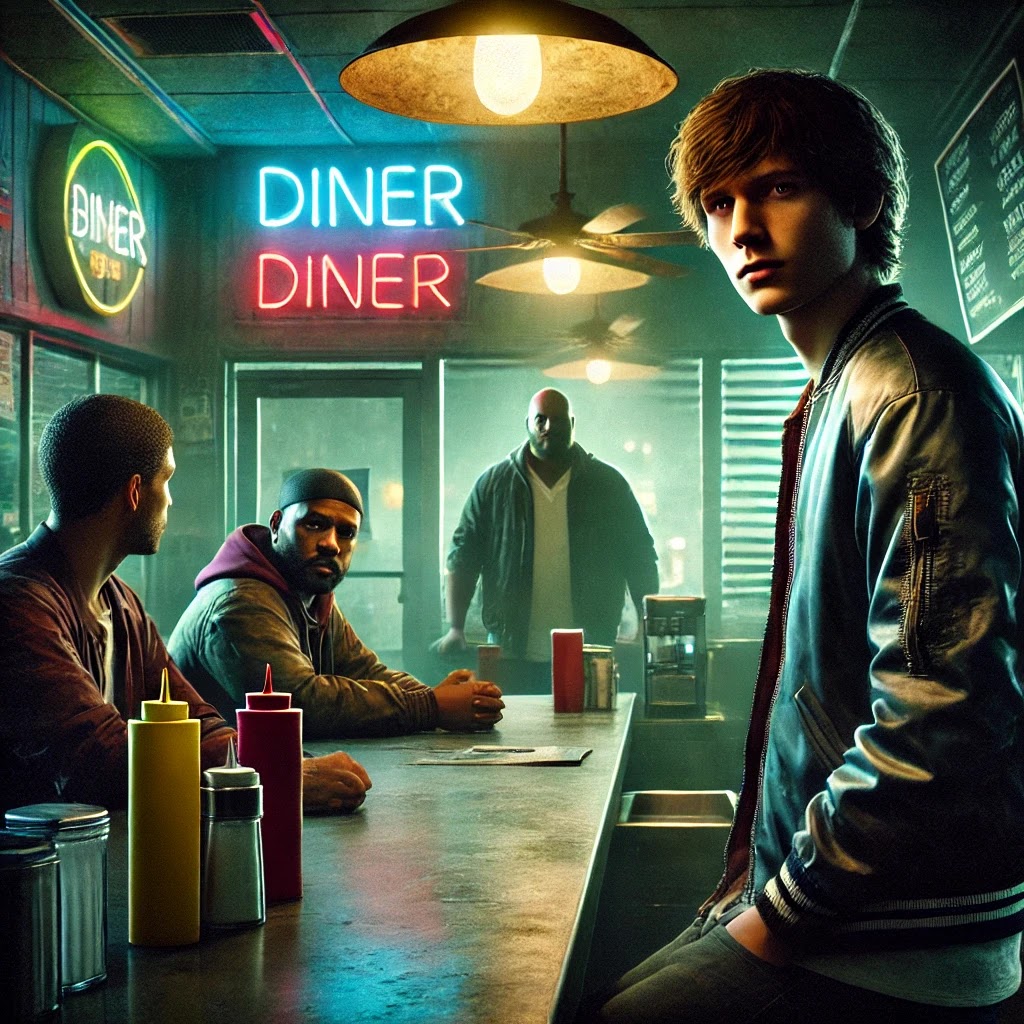
The Hitmen by Olivia Salter / Short Story / Suspense


In a late-night diner, a young man is caught in the middle of a deadly standoff between two dangerous men and an enigmatic figure named Garrett. As the tension escalates, Miles must decide if he’ll continue to live his quiet life or take a risk that could change everything.


The Hitmen


By Olivia Salter


The bell above the diner door jingled, sharp and jarring in the silence of the late-night shift. Two men walked in, their presence cutting through the monotony like a blade.

One was tall and lean, dressed in a bomber jacket that screamed money, his shoes too clean for this neighborhood. His eyes scanned the room coldly, taking in every detail, as if measuring the air itself. The other was shorter, stockier, his hoodie pulled low over his face, the hood casting shadows that made him look like a ghost. He moved with the jittery energy of someone used to violence, always waiting for something to break.

Miles, the young man behind the counter, looked up from his phone. His stomach dropped. He’d been scrolling through job listings that promised quick cash but felt like dead ends, just like this place. His fingers trembled for a moment as he locked his phone. These two didn’t belong here. And he wished, more than anything, that he didn’t either.

The tall one slid onto a barstool at the counter, his movements slow and deliberate, like he had all the time in the world. He didn’t look at Miles, just gestured for coffee, his voice flat, almost robotic.

"Coffee," he said, and then pulled out his phone, eyes glued to the screen, as though this wasn’t the least bit out of place.

The shorter man followed, sitting next to him, his eyes flicking between the menu on the wall and Miles. He let out a low chuckle.

"Two burgers," he said, his smirk wide. "Extra onions and pickles."

Miles nodded and turned to the grill, his hands moving automatically. Every part of him was alert, tense. He could feel their eyes on him, heavy and expectant. The silence stretched like a live wire, vibrating with something dark.

He placed the plates in front of them, his hands steady despite the sweat on his palms. The tall man didn’t look up, but the shorter one finally did, his eyes narrowing as he leaned forward, his voice dropping.

"So, when does he show?"

Miles froze. His throat went dry. “Who?”

The shorter man’s grin widened, a glint of amusement in his eyes. “You know who. Big guy. Garrett.”

Miles forced a shrug, but it didn’t feel natural. "I don’t know any Garrett."

The tall man’s gaze sharpened, locking on Miles. His voice was a calm blade. "We know he’s been here."

The words hit Miles like a slap, but he said nothing, just wiped the counter with a rag, his stomach churning. What the hell did they want with Garrett?

The shorter man leaned closer, his voice a low whisper. "You’ll see him soon enough. You don’t want to keep us waiting." He laughed quietly, the sound sharp, like a knife scraping across glass.

Miles’ heart hammered in his chest. The tension thickened, filling every inch of the small diner. He kept his eyes on the counter, his hands moving automatically as if they had a mind of their own.

Minutes dragged on. The Hitmen ate in silence, their conversation muted, their presence suffocating. The clock ticked loudly in the background. Miles’ phone buzzed in his pocket, but he didn’t dare check it.

Then, the door jingled again, and the air seemed to freeze.

Garrett walked in.

He was broad, heavyset, with the kind of weariness that came from years of running, fighting, surviving. His eyes swept the room, noting the two men at the counter. Recognition flickered in their eyes.

"Garrett," the shorter man said with false cheer, a smile spreading on his face. "Finally."

Garrett didn’t smile back. He didn’t sit. He stood there for a moment, his eyes hardening. "Whatever you’re here for, it’s not happening."

The tall man raised an eyebrow, almost bored. "We’re just here to talk."

"Then talk," Garrett said, his voice a low rumble, rough from years of hard living. "But I’m telling you right now, you won’t get what you want."

The shorter man chuckled darkly. "It’s cute how you think this is optional."

Miles felt the air grow thick. His hand hovered near his phone, the temptation to call someone growing stronger. But his mind raced—who would he even call? The cops? It would be too late.

"You don’t scare me," Garrett said, his voice rising, his body tense but steady. "And you don’t scare anyone who matters."

The tall man let out a slow breath, as if the situation was starting to bore him. "We’re not here to scare you, Garrett. We’re here to end this."

The words hung in the air, and Miles felt his stomach flip. He could see it in Garrett’s eyes. He wasn’t afraid. But could he fight them off? Could he win?

But then, Garrett did something that made everyone in the diner freeze.

He laughed. It wasn’t loud, but it was enough to fill the room with a dangerous energy. "You think I’m just going to roll over for you?" His hand slid into his jacket, and for a moment, Miles thought it was a gun. But then Garrett pulled out a phone, holding it up to show the screen. "I’m not that stupid," he said, his voice steady. "You’re already done."

The shorter man’s grin dropped. The tall man leaned forward, his eyes narrowing, studying the phone with suspicion.

“What is this?” the shorter man barked.

“Insurance,” Garrett replied, his lips curling into a sly smile. "This feed’s live. Anything happens to me, the people I work for will know. And they’ll know it was you."

Miles' pulse quickened. He hadn’t expected Garrett to be so prepared, so calm under pressure. Was it enough to stop the Hitmen?

The Hitmen exchanged a glance. The tall one scowled. “Cute trick,” he muttered, pulling a small device from his pocket. "Let’s see how smart you are now."

He flicked the switch on the jammer, and Garrett’s phone screen went blank, the feed cut off.

Garrett’s jaw tightened, but he didn’t flinch. "So that’s it, huh? You two think you’ve got all the power?" He didn’t back down, not even an inch.

The taller man smirked, his voice a low growl. "We don’t think, Garrett. We know."

The shorter man stood up slowly, cracking his knuckles. "You had your chance. We don’t like dragging these things out."

Miles could hear the sound of his own heartbeat pounding in his ears. His hand hovered over his phone, but his fingers felt numb, useless.

Garrett’s voice cut through the tension. "You think you’re untouchable, but you’re just foot soldiers. You don’t even know the game you’re playing."

The tall man laughed, low and dangerous. "You always did talk big. It’s probably what got you into this mess."

Garrett didn’t flinch, but his voice hardened. "I’m not the one in a mess." His eyes flicked toward Miles. "Kid, you don’t owe these clowns anything. You don’t have to watch this."

The words hung in the air like a rope around Miles’ neck. He didn’t know what to do. He was frozen, caught between two forces, both equally dangerous.

The taller man’s patience snapped. He pulled a gun from his pocket, the cold steel gleaming under the flickering neon light.

The room went deathly still.

"I warned you," Garrett said, his voice a low growl.

But before the gun could fire, the sound of sirens wailed outside. They were faint at first, but they grew louder, closer.

The shorter man cursed under his breath, glancing at the window. "You gotta be kidding me."

The tall man’s face twisted in frustration. “You called them?”

Garrett smiled faintly, his eyes never leaving the Hitmen. "Did you think I came here without a backup plan? You two are predictable."

The Hitmen exchanged a glance, and without another word, they backed off, shoving the gun back into the taller man’s jacket. They hurried toward the door, the sirens getting louder with each passing second.

Garrett didn’t move. He stood still as the two men vanished into the night.

Miles’ legs gave out, and he leaned heavily against the counter, his breath shaky. His phone had slipped from his hand and clattered onto the surface, screen cracked.

Garrett strolled over to the counter, his movements casual, like he hadn’t just stared death in the face. He picked up his coffee, took a sip, and set it down without a word.

"You alright, kid?" Garrett asked.

Miles nodded shakily, though his mind was racing. “I didn’t call them.”

Garrett gave him a knowing look but didn’t say anything. Instead, he pulled out a second phone from his pocket. "I told you, you’ve got a choice. You made the right one tonight."

Miles couldn’t shake the feeling that his life had just changed, that he’d crossed a line into something darker, something far beyond the confines of this greasy diner.

Before he could say anything more, the door swung open, and two officers stepped inside, their hands resting on their holsters.

"They left in a hurry," Garrett said, nodding toward the booth where the Hitmen had been sitting. "You’ll find what you need there."

The officers exchanged a glance before moving toward the booth, their boots clacking against the worn linoleum. Miles stood frozen, still processing everything that had just unfolded, the weight of the moment too heavy to carry. The sirens outside grew louder, but the stillness inside the diner felt like a tomb.

He couldn’t look at the officers. He couldn’t look at Garrett, either, even though his mind was racing, trying to piece together the puzzle that had just exploded into his life. One minute, he was flipping burgers and daydreaming about a way out of this dead-end job, and the next, he was caught in the middle of something that felt like it had been brewing for years, something that had nothing to do with him but now had everything to do with him.

Garrett didn’t seem concerned about the cops. He finished his coffee, slowly and deliberately, as if he had all the time in the world.

Miles watched him, the pit in his stomach deepening.

“You’re not like them,” Miles muttered, his voice barely a whisper.

Garrett didn’t respond right away. Instead, he pushed the empty cup away and looked Miles straight in the eye, a quiet understanding between them.

“Not like them?” Garrett repeated, his tone calm, unshaken. “No. I’m better than them.”

Miles blinked, taken aback. He didn’t know whether to be scared or impressed. Garrett’s confidence was unnerving, but there was something about it that made Miles feel like maybe, just maybe, he was looking at a man who knew exactly how to survive.

“What happens now?” Miles asked, his voice trembling.

Garrett smiled faintly, but there was no warmth in it. “You go back to your life, kid. The cops will clean this up. I’m just here for the cleanup. People like those two? They don’t walk away without consequences.”

The officers were returning now, one of them carrying something from the booth, a file, maybe. Their eyes flicked toward Garrett, but neither of them said a word to him. They were too busy with the scene, too busy with their own agenda to bother asking him questions.

Miles couldn’t shake the feeling that Garrett wasn’t just an ordinary guy. Something about the way he carried himself told Miles there was more—far more—under the surface. And he didn’t think Garrett was just talking about the Hitmen. He was talking about something else. Something dangerous. Something that had just crossed his path, whether he was ready or not.

Before Miles could ask another question, Garrett stood, his movements slow and deliberate. He reached into his jacket and pulled out a second phone, something sleek and expensive-looking.

“You made the right choice,” Garrett said again, his voice barely audible. “Don’t forget that. Most people don’t make it out when they’re in the middle of this shit.”

The door swung open, and Garrett was already stepping outside, his silhouette disappearing into the night, swallowed up by the darkness.

Miles stayed frozen, his eyes fixed on the empty doorframe. He couldn’t explain it, but something in him had changed. Something about the way Garrett handled the situation, the quiet control he exuded, had somehow shifted the air in the diner, left a mark on him.

The officers didn’t seem to notice as they finished their investigation and walked toward the door.

One officer looked back over his shoulder, raising an eyebrow. “You’ll be okay here, kid?”

Miles blinked, his mind foggy. “Yeah. I’ll be fine.”

The officers nodded, one of them casting a long, final glance at the booth before they left.

The door swung shut behind them, and Miles was left alone again, the quiet of the diner feeling like a weight pressing down on his chest. He hadn’t expected any of this to happen. He hadn’t expected to be involved in something so... raw.

For the first time in a long time, he felt his future press in on him—so heavy, so near. And for the first time in a long time, he wondered if this place had been his life all along. The burgers, the coffee, the loneliness of the late-night shift—was that really all there was? Or had Garrett’s brief appearance cracked open something larger, something more dangerous, that Miles couldn’t quite name?

He glanced at the counter, his hands trembling as he wiped it down one last time, the fluorescent lights buzzing overhead. The world outside still felt far away, distant. But the diner? The diner was his world. It was the cage that had kept him here. Now, he wasn’t so sure.

The door jingled again, but this time it wasn’t the Hitmen returning. A woman stepped inside, her eyes scanning the room before landing on Miles. She looked familiar, though he couldn’t place her face.

She hesitated, then approached the counter.

“You alright, hon?” she asked, her voice soft but insistent.

Miles nodded, though he wasn’t sure if he was lying or telling the truth. "Yeah. Just... tired."

She smiled kindly, but her eyes held something else, something a little too knowing, as if she understood the weight that had settled on his shoulders.

“You sure?” she pressed.

He took a breath, his hand gripping the counter as he looked back at her, something shifting in his chest.

“I think I need to go,” he said quietly. “I need to get out of here.”

She raised an eyebrow, a knowing smile forming on her lips. “Maybe it's time you did.”

As he wiped his hands on his apron and grabbed his jacket, Miles felt a strange sense of finality settle in him. Maybe Garrett was right. Maybe he had a choice. He’d made the right one tonight. But that didn’t mean the story was over.

No, that was just the beginning.


Visit Olivia Salters Author Page at Amazon.


© 2026 Olivia Salter - All rights reserved.

No part of this book may be reproduced, distributed, or transmitted in any form without the express written permission of the author.


Wednesday, January 8, 2025

The Deadly Bloom by Olivia Salter / Short Story / Thriller, Suspense, Survival Drama


A botanist's peaceful life turns into a living nightmare when she's forced into a deadly game of survival, her prized plant as the prize. As she battles desperate intruders and uncovers a sinister organization's true intentions, she must use her expertise and determination to outwit those who seek to control her.


The Deadly Bloom


By Olivia Salter


Word Count: 5,282


The greenhouse did not smell like a laboratory; it smelled like the bottom of a forest after an August rain. It was a heavy, respiration-dense heat that clung to the inside of Marisol’s wrists and fogged the lower four inches of the triple-paned glass. Outside, the gray, salt-scoured Oregon coast was frozen in a permanent, late-afternoon squint. Inside, under the high-pressure sodium fixtures, it was the tropics.

Marisol worked with a camel-hair brush, her strokes so light they barely disturbed the fine, pale down on the underside of the Excoecaria hybrid. She called it the Blazing Thorn, though its true ledger name was E. var. flamma. It wasn’t beautiful in the commercial sense—it didn't possess the symmetrical, waxen perfection of an orchid. It was a low, knotted thing, its stalk grey as driftwood, but its leaves were shot through with lateral veins that pulsed a dark, sub-dermal crimson when the light hit them at thirty degrees.

And it was heavy. When she lifted the terracotta pot to check the drain holes, she could feel the dense, muscular pull of its root system. It absorbed iron at three times the rate of any known euphorbiaceous plant, leaving the surrounding soil bleached and chalky.

She heard the door click. Not the main entry with the keypad—the small, brass-fitted ventilation hatch at the base of the north wall, the one she left unlatched by an inch to let the coastal humidity equalize.

Marisol didn’t turn around. She finished her stroke, deposited the brush into a jar of distilled water, and then reached for her paring knife—the short, curved Victorinox she used for grafting.

"The seal on the frame is rotting," she said to the steam. "You’re letting the salt in."

There was no answer, only the wet, dragging slide of rubber-soled boots across the cedar duckboards.

When she finally turned, her back against the zinc potting bench, she didn't find a corporate courier or a local inspector. The man was small, his shoulders hitched high around his ears as if he were trying to disappear into the collar of an oversized waxed jacket. He was soaked through, leaving a trail of gray, sandy water on her clean redwood floor. His skin had the yellow, translucent quality of lard left out on a counter, and his fingers—stubby, split at the nails—were twitching against the seam of his trousers.

"You Dr. Vargas?" his voice was flat, thin, scraped clean of any local cadence.

"I am. And this is private property."

"The fence was down."

"The fence has six strands of high-tensile wire and a padlock," Marisol said, keeping her thumb flat against the spine of her knife. "What do you want?"

The man didn't look at her; his eyes were fixed on the Excoecaria. His pupils were huge, dilated to the edge of the iris despite the glare of the growth lamps. "They said it was smaller. They said it would fit in a standard cooler."

"Who said?"

He reached into his pocket. Marisol tensed, her knuckles whitening on the wood handle, but he only withdrew a square of heavy, cream-colored cardstock. He didn't offer it to her. He laid it flat on the edge of the potting soil bin, his hand shaking so violently he knocked over a small pot of unsprouted liverwort.

"I have three days," he whispered. "They’re in the cellar under my sister's place in Tillamook. Two men. They don't talk. They just sit on the wood chest where she keeps the winter blankets."

Marisol looked from his face to the cardstock. Printed across the center in a small, elegant copperplate font was a single line: The Garden requests the return of its inventory.

"I don't belong to a cooperative," Marisol said, her voice dropping into the quiet register she used when she was trying to calm an overheated compressor. "I haven't taken a grant from Berlin or Tokyo in five years. This specimen was cultured from a wild cutting collected in the Ryukyu Islands in 2021. It's registered under my personal license."

"They don't care about the license," the man said. He finally looked at her, and she saw the thin, red crust of salt-rheum in the corners of his eyes. "They told me if I didn't bring the pot, they’d fill the cellar with sulfur gas. You know what that does to a person's lungs? My dad worked the fruit lines in Yakima. I know what it does."

He took a step forward, his hands rising, fingers hooked like old roots. He wasn't a professional. He was a terrified, stupid instrument, and that made him twice as dangerous as anyone with a silencer.

"Don't," Marisol said.

"Give it here. Just let me take it. You can write it off. You're a doctor, you got insurance—"

He lunged. He didn't have a weapon, just the clumsy, forward weight of a man who spent his life moving crates. Marisol didn't swing the knife; she sidestepped, her thigh catching the corner of the bench, and grabbed a five-gallon bucket of dry lime from the shelf below. She didn't throw the bucket—it was too heavy—but she tipped it forward, dumping thirty pounds of fine, white calcium hydroxide directly across the duckboards.

The man’s boots hit the powder. He lost his footing on the wet wood beneath, his arms windmilling as he went down hard on his hip. The impact broke a row of starter flats, sending plastic liners and black loam flying into the air.

He screamed—not from the fall, but because his hands had landed flat in the lime. Calcium hydroxide on wet skin doesn't burn instantly; it waits for the moisture to activate, then it begins to pull the water out of the tissue with a dry, chemical greed.

"Get up," Marisol said, her chest heaving, the knife held low at her hip. "Get up and go to the sink."

The man was sobbing, scrubbing his white-filmed palms against his greasy jacket, making it worse. "I can't go back without it. They’re sitting on the blanket chest, lady. They’re sitting right on it."

"The sink," she hissed, grabbing him by the greasy shoulder of his coat and hauling him toward the cast-iron basin at the back of the house. She turned the cold tap on full, the well-water rushing out with an iron-heavy smell. She shoved his hands under the stream.

The white paste dissolved into a milky sludge, running down the drain. The skin beneath was already angry, mottled with red patches where the chemical had begun its work.

"Who are they?" she asked, her mouth close to his ear while the water roared.

"The Garden," he blubbered, his face pressed against the corrugated splashback. "That’s all they said. They got a flat in Astoria. Above the old ship chandler’s. They have boxes of those cards. Hundreds of 'em."

Marisol turned his head toward her by the chin. Her fingers were wet with his sweat and her own lime-dust. "How many people are coming here?"

"I don't know. They said I was the first because I knew the road. They’re buying up the old packing houses down by the slough. They got trucks, lady. Big, white ones with no names on the doors."

She let go of him. He stayed there, his hands dripping into the basin, his forehead resting against the cold copper pipe.

Marisol walked back to the Excoecaria. The plant hadn't been touched. Its crimson-veined leaves were perfectly still under the gold glare of the lights. She looked down at the cream-colored card on the soil bin. When she picked it up, she realized the paper wasn't pulp; it was hemp-based, heavy-gauge, water-resistant. The kind used by maritime outfits for logbooks.

"Go," she said without looking back at the sink. "Take your truck and go south. Don't go back to Tillamook."

"They'll find her," he whispered.

"They're already there," Marisol said, her voice flat. "If they sent you with a card, they aren't waiting for an answer. They’re waiting for an excuse."


She didn't sleep. By 4:00 a.m., the coastal fog had crawled through the broken ventilation latch, turning the greenhouse into an oyster-colored lung. Marisol sat at her desk in the small office attached to the rear of the structure, an old, green-shaded banker’s lamp casting her shadow long across the pine floorboards.

Before her lay three notebooks bound in black oilcloth. These were her private ledgers—the ones she hadn't digitized, the ones that didn't exist on the server at Oregon State University where she used to hold a chair in economic botany.

The entries were ten years old, written in her tight, left-handed cursive during her final summer in the Ryukyu chain.


July 14. Specimen found three miles inland from Shuri, growing in the limestone crevices near the old sugar mill. Local name: Chi-no-namida (Tears of Blood). The sap contains an unclassified latex with an extraordinarily high concentration of daphnane-type diterpene esters. Initial skin contact causes immediate vesication, but the secondary systemic effect is what concerns the locals. The goats that forage near the ruins don't die of rot; they die of respiratory arrest within twenty minutes of browsing. The local elders claim the smoke from the wood will blind a man permanently.

She dipped a glass rod into a small bottle of isopropyl alcohol and cleaned the blade of her Victorinox.

The man at the sink had been right about one thing: she had insurance, but it wasn't the kind issued by Lloyds. Her insurance was thirty jars of dried Dieffenbachia root stored in the crawlspace beneath the kitchen, four mature specimens of Ricinus communis growing in the unheated cold-frames out back, and the knowledge that nature never created a defense mechanism that couldn't be concentrated with an old iron pot and a propane burner.

She went down the short stairs into her cellar. The air down here was different—dry, smelling of onions and the gray silt she used to store her dahlia tubers.

In the corner stood her extraction rig: a simple, glass Soxhlet extractor she’d salvaged from the university surplus pile when the department cut her funding for "lack of commercial applicability."

She didn't use the Excoecaria. That was her seed stock, her life's work. Instead, she took down a jar of dark, oily seeds she’d harvested from her Ricinus crop the previous October. Castor beans. To the untrained eye, they looked like fat, mottled beetles. To a biochemist, they were small, self-contained factories for the production of a ribosomal-inactivating protein that could stop a horse's heart if it found its way into the bloodstream through a broken fingernail.

She didn't make the poison—that was illegal, and more importantly, it was messy. She made a paste. A thick, grey mucilage mixed with dimethyl sulfoxide—a heavy industrial paint solvent that cut through the skin's lipid barrier like water through gauze—thickened with pine resin and linseed oil. It had no smell, but if you smeared it along the iron latch of a door or the rim of a window frame, anyone trying to force the lock without heavy rubber gloves would find the toxin carried straight through their epidermis into the capillaries within minutes.

As she worked the mortar, the pestle making a rhythmic scritch-clack against the stone, she heard the first vehicle.

It wasn't a truck. It was a small, four-cylinder sedan, its engine timing off, missing on the third cylinder as it turned off the highway onto her gravel lane. It didn't have its lights on. She could hear the crunch of the river stone she’d laid down five years ago to keep the mud from swallowing her driveway.

Marisol blew out the candle on her workbench. In the dark, her ears became her eyes.

The car stopped eighty yards out, near the line of old, salt-killed spruces. Two doors closed—not the heavy clunk of an old Ford, but the thin, tinny pop of a Japanese import.

She climbed the cellar stairs, her knees popping in the quiet house. She didn't feel fear; she felt a cold, academic curiosity. The Garden had sent a broken man with a card first to see if she was soft. Now they were sending the mid-level staff.

She moved through her kitchen without turning on a light. She knew every squeak in the fir floorboards; she knew that if she kept her weight to the outer edge of the doorframe leading to the porch, she could move without a sound.

Through the window, she saw them. They were silhouettes against the gray fog, two figures in hip-length oilskins. One carried a short, iron crowbar; the other had nothing in his hands, but his coat was unzipped, the hem pulling back on the left side where something heavy hung from his belt.

They didn't go for the greenhouse. They went for the house.

Marisol reached onto the top of the refrigerator where she kept her winter boots. Beside them sat a wide-mouthed glass jar containing three pints of crude oil mixed with the crushed leaves of Urtica ferox—the New Zealand tree nettle. She’d imported the seeds under a false customs declaration three years ago. The trichomes on the leaves were like small hypodermic needles; they didn't just contain formic acid like the local nettles; they contained an unclassified neurotoxin that caused a condition the Maori called ongaonga—a permanent, neurological burning that could last for months.

She stepped onto the back porch. The wind was coming off the water, cold and smelling of kelp.

"The key is under the mat," she called out into the dark.

The two silhouettes froze. The one with the crowbar turned his head toward the sound of her voice, his face a pale oval in the fog.

"Dr. Vargas?"

"The key is under the mat," she repeated, her voice perfectly conversational. "But if you touch the brass doorknob, you'll need a hospital bed by sunrise. I’ve treated the metal with a transdermal ricin extract mixed with DMSO. It pulls right through the skin."

The man with the crowbar laughed. It was a wet, smoker's chuckle. "You think we're stupid? We know who you are. We know you haven't had a live culture license since the state pulled your accreditation."

"I don't need a license to grow weeds," Marisol said.

The second man—the one with the heavy coat—took three steps toward the porch steps. He didn't pull a gun, but he kept his hand inside his pocket. "The board wants the notebooks, Doctor. The ones from Okinawa. And the three mature specimens in the south bay. We have a truck coming at daylight with a flatbed. Don't make us clear the house first."

"Who is the board?"

"People with more money than you have names for," the man said. He reached the bottom step. His boot clicked against the stone. "We're not here to argue with an old woman who talks to her ferns. Get inside."

Marisol didn't move. She held the glass jar by its wire bale. "You should have checked the wind before you came up the lane."

She didn't throw the jar at them. She threw it down onto the hot-water discharge pipe that ran from her cellar kitchen to the drainage ditch beside the porch. The pipe was old iron, uninsulated, carrying the boiling overflow from her extraction rig's cooling system.

The glass shattered against the iron. The crude oil didn't catch fire—it wasn't hot enough for that—but the sudden heat vaporized the volatile oils from the crushed Urtica leaves, creating a small, grey plume of steam that the sea wind caught and drove directly down the steps.

The man in the heavy coat took one breath of it.

He didn't scream. He made a sound like a wet towel being snapped against a wall—a hard, involuntary spasm of the glottis as his vocal cords instantly constricted. He went down on his knees, his hands clawing at his throat, his face disappearing into the grass.

The man with the crowbar backed away, his boots skittering on the gravel. "What did you do? What is that?"

"It’s an allergen," Marisol said, her voice rising slightly over the sound of the surf. "His immune system thinks he’s being stung by five thousand bees simultaneously. If you don't get him to an emergency room with an epinephrine drip within ten minutes, his tongue will swallow his throat."

The man with the crowbar looked at his partner, who was now rolling in the wild clover by the path, his chest making a high, whistling rattle like an old bellows. He didn't try to touch Marisol. He grabbed his partner under the arms, dragging him back toward the tinny sedan, his boots slipping in the mud.

Marisol watched them go. She didn't feel the adrenaline hit until the red tail-lights of the car disappeared over the rise toward the highway. Then her hands began to shake—not with fear, but with the cold realization that her sanctuary was gone.

She went back inside, pulled the black oilcloth notebooks from her desk, and put them into a canvas rucksack. Then she walked into the greenhouse, lifted the Excoecaria out of its terracotta pot, and wrapped its root ball in a wet burlap sack. She didn't look at the rows of seedlings or the glass walls she’d spent seven years cleaning with vinegar and newspapers.

She went to the kitchen, took the propane torch she used for searing weeds along the path, and carried it down to the cellar. She turned the valve until the gas hissed, struck the flint, and held the blue cone of flame against the dry pine joists beneath the living room floor.


The motel was called The Shilo Inn, but it had nothing to do with the chain. It sat on a strip of gravel between a diesel repair shop and a swampy creek outside of Astoria, its neon sign humming with a dry, insect-like click.

Marisol sat on the edge of the bed, the wrapped root ball of the Excoecaria sitting in the porcelain shower stall behind her to keep it from drying out. The room smelled of old carpet shampoo and tobacco smoke from 1994.

There was a knock at the door—three light taps, then two heavy ones.

She didn't open it. She took her grafting knife from her pocket and opened the blade. "Lila?"

"It’s me," a voice said through the hollow-core plywood. "I brought the log from the harbor office."

Marisol slid the chain back.

Lila was twenty-six, but she had the gray, institutional look of someone who had spent her teens in juvenile diversion programs and her twenties working sixty-hour shifts at the fish processing plants down by the docks. Her hair was chopped short with kitchen shears, and she wore a grease-stained canvas apron over her hoodie.

She slid into the room like salt water through a bad seam, her eyes immediately going to the bathroom door where the plant was stored.

"The house is still burning," Lila said, dropping a thick, manila folder onto the Formica table. "The volunteer fire department from Gearhart showed up around five, but they couldn't get within fifty feet of the greenhouse. They said the smoke smelled like burning rubber and made their eyes bleed. Two of them are in the hospital in Seaside."

"They shouldn't have used water," Marisol said. "Water activates the latex in the bark."

"They didn't know," Lila said. She sat down on the single plastic chair, her knees together, her hands tucked into her sleeves for warmth. "Nobody knows but you, Doc."

Marisol opened the folder. Inside were photocopies of the harbor logs from the Port of Astoria for the last three months. Every entry was flagged with a yellow highlighter where a vessel named The Cerinthe had cleared customs.

"It’s registered out of Monrovia," Lila said, pointing a dirty fingernail at the ledger. "But the fuel bills are cleared through an agency in Zurich. The same one that bought the old ice house by the river last winter."

"Who signed the bills?"

"A guy named Calloway. Ethan Calloway. The harbor master said he has an office in the old bank building on Commercial Street, but he’s never there. He spends his time on the water."

Marisol closed her eyes.

She could still smell the tea he used to drink—that cheap, smoky Lapsang Souchong he kept in a tin behind the balances in the university lab. He had been the one who signed her travel vouchers for the Ryukyu trip. He’d been the one who told her that her work on plant-derived toxins was "the only thing in the department worth a damn."

"He isn't a botanist," Marisol said to the dark behind her eyelids. "He’s an accountant who knows how to read a chemical journal."

"He’s got four men at the ice house," Lila said. "They’re loading crates. Big ones, insulated with styrofoam. I saw them from the pier this morning. They aren't fish crates, Doc. They have bio-hazard labels on the corners, but they’ve been scraped off with a wire brush."

Marisol stood up and walked to the window. Across the highway, the gray waters of the Columbia River were moving toward the bar, six miles of flat, muscle-colored current that could swallow an ocean liner if the pilot missed the channel by twenty yards.

"Why did you leave them, Lila?"

Lila didn't look up. Her fingers were twisting the hem of her apron. "They wanted me to mix the sprays. For the cranberries down in Long Beach. They bought three hundred acres of bogs through a shell company. They told me it was a new kind of liquid fertilizer that would kill the weeds without hurting the fruit."

"And?"

"I saw the deer," Lila whispered. "Two of 'em came out of the woods near the ditch where we were testing the pumps. They drank from the runoff. They didn't even make it back to the trees. They just… their legs went stiff, like iron bars, and they fell over into the brush. When I went to look, their tongues were black."

She looked at Marisol, her eyes small and dark in her pale face. "They told me if I talked to the county agent, they’d tell the sheriff I was the one who broke into the pharmacy in Warrenton three years ago. I didn't do it, Doc. I was just in the car. But nobody believes a girl with my name."

Marisol walked into the bathroom, lifted the wrapped Excoecaria out of the tub, and set it on the sink counter. The burlap was turning yellow where the sap had seeped through the fibers.

"We aren't going to the county agent," Marisol said.

"Then what are we doing?"

"We're going to see Ethan," she said. "He always liked to look at my notebooks before they were published. It’s only polite to show him what I’ve been working on since he left the university."


The old bank building on Commercial Street had twelve-foot ceilings and a floor made of small, hexagonal marble tiles that had turned the color of mutton fat after eighty years of wet boots.

Ethan Calloway did not look like a corporate pirate. He looked like an emeritus professor who had spent too much time in the sun and too much money on his tweed jackets. His hair was thin, white, and combed straight back from a high, freckled forehead. He sat behind a massive oak desk that had nothing on it but a brass desk clock and a small, green ceramic pot containing a single, stunted geranium.

"You look tired, Marisol," he said when the door clicked shut behind her. He didn't look up from his ledger.

"I’ve been traveling," Marisol said. She stayed near the door. Lila was outside on the landing, her back against the frosted glass, holding an old brass fire extinguisher she’d taken from the motel hallway.

"The fire at your place was a shame," Ethan said, finally setting his pen down. He looked at her with that wide, pale gaze that had once made her think he was a genius. "The state fire marshal thinks it was an electrical fault in the growth lamp ballast. They found some bone fragments in the cellar, but they think it was an old dog."

"It was a pig," Marisol said. "I kept six sides of salt pork in the chest down there. For the lard."

Ethan smiled. It was a small, dry movement of his lips. "Always practical. That’s what I told the board. I said, 'Marisol won't throw her notes into the sea. She'll bring them to me because she doesn't have anyone else who can read them.'"

He reached into his drawer and withdrew a checkbook bound in black calfskin. "We’re prepared to offer sixty thousand for the Ryukyu logs. And a retainer. Three thousand a month to oversee the Long Beach project. You can have the lab at the ice house. It has a modern ventilation hood. No more lime on the floor."

Marisol walked to the desk. She didn't look at the checkbook. She looked at the small geranium in the green pot.

"This is Pelargonium graveolens," she said, touching one of the fuzzy leaves with her bare thumb. "It’s been starved of nitrogen. You can tell by the yellowing at the margins."

"It’s an old office," Ethan said, his voice dropping its academic warmth. "We don't get much light here."

"You don't get any light here, Ethan," she said.

She withdrew her hand from her pocket. She wasn't holding a knife, and she wasn't holding a glass vial. She held a small, plastic spray bottle—the kind used by jewelers to clean watch faces.

"The man you sent to my house—the first one—told me about the cellar in Tillamook," she said.

Ethan’s eyes didn't leave her hand. "He was a local hire. Cheap. Not particularly intelligent."

"He was terrified," Marisol said. "And the two men you have sitting on the blanket chest in that cellar—they’re from the security firm in Portland, aren't they? The ones who handled the strike at the paper mill?"

"They're logistical assistants," Ethan said. He reached for his desk clock, his fingers moving slowly, deliberately.

"If you touch the clock," Marisol said, "I’ll clear the air in this room."

"With what? More nettle juice? We have masks in the hall, Marisol. We aren't amateurs."

"It’s not nettle juice," she said. She leaned over the desk, her face six inches from his. He could smell her—she didn't smell like earth anymore; she smelled like smoke and the vinegar she’d used to wash the soot off her skin. "I spent the last three hours in the motel room with the Excoecaria. Do you know what happens when you cut the main taproot while the plant is in its dormant cycle?"

Ethan’s eyes widened slightly. "It bleeds."

"It doesn't bleed latex," Marisol said. "It exudes an alkaloid called daphnetoxin. It’s water-soluble. I ran it through the coffee maker three times. The room smelled like almond paste. It was very pleasant."

She tilted the small spray bottle toward the stunted geranium.

"You think I'm bluffing," she whispered, her thumb tightening on the pump. She pressed it once, a half-stroke. A microscopic, dry mist hissed from the nozzle, completely invisible in the dim office light.

Ethan didn't blink, but his nostrils flared as the faint scent of crushed almonds reached him across the oak desk. His hand froze an inch from the brass clock. His finger twitched.

"You're a researcher, Marisol," he said, his voice dropping an octave, losing its smooth cadence. "You don't have the stomach for a strike like that. You spent twenty years writing papers on sustainability."

"I spent twenty years watching you sell my work to companies that use it to kill the brush along railway lines so they don't have to hire men with scythes," she said. "I’m sixty-two years old, Ethan. My house is a hole in the dirt. My plants are dead except for the one in my bag. I don't have a syllabus for next semester."

She laid the small bottle flat on his ledger, her palm resting on top of it, holding the trigger down just enough to keep the spring tense.

"Pick up the phone," she said. "Call the men in Tillamook. Tell them to leave the cellar. Then call the crew at the ice house. Tell them to dump the flats into the river."

Ethan stared at her palm on the bottle. He looked at the window, then back at her eyes. For three long seconds, the only sound in the room was the heavy, rhythmic clicking of the brass desk clock.

Then, slowly, his jaw tightening until the muscle bunched at his cheek, he reached out with his left hand, picked up the receiver, and began to dial.


The cargo ship The Cerinthe did not leave the dock at daylight. It sat in its berth at the foot of 14th Street, its diesel generators coughing a gray, oily smudge into the rainy sky, until the tide turned at 3:12 p.m.

Marisol and Lila stood on the wooden pier under a single, shared oilskin coat. At their feet sat the canvas rucksack containing the black notebooks and the wrapped root ball of the Excoecaria.

The white trucks were gone from the ice house. A trail of small, green leaves—the rejected starter plants from the Long Beach project—lay scattered across the gravel where the loaders had cleared the bays with a fire hose. They looked like bright, artificial beads against the black mud.

"They'll just build another one," Lila said, her hood pulled low over her forehead. "In Coos Bay. Or California. He’s got the money."

"Let him," Marisol said. She reached into her pocket and withdrew the seed packet—the one she’d taken from her kitchen before she set the fire.

She didn't open it. She held it in her palm, letting the rain soak through the paper until the small, grey disks inside began to swell, their outer husks turning soft and gelatinous. These were the seeds of Ulex europaeus—the common gorse. But they weren't common. She’d spent three years cross-breeding them with a mountain variety from the Pyrenees until she had a strain that could grow in pure sand, that could withstand sixty-knot winds, and whose thorns were so dense that no animal could pass through them. Once it took hold in the coastal dunes, it would take twenty years and three million dollars in herbicides to clear a single acre.

She dropped the wet packet over the edge of the pier.

The current caught it instantly, pulling it down into the dark, cold water where the river met the sea. It would float south with the longshore drift, landing on some spit of sand near Clatsop or Tillamook, where the roots would find the dark and begin their work.

"Come on," Marisol said, turning her back to the water. "The bus to Crescent City leaves at four."

Lila picked up the rucksack. She looked back once at the gray shape of The Cerinthe as it cleared the bridge, its foghorn blowing once—a long, low, iron groan that sounded like something dying in the woods.

"You think they'll look for us there?" Lila asked.

"They'll look for a botanist," Marisol said, her boots crunching on the wet gravel as they walked toward the highway. "We aren't going to grow anything where we're going. We're just going to clear the ground."


Visit Olivia Salters Author Page at Amazon.


© 2026 Olivia Salter - All rights reserved.

No part of this book may be reproduced, distributed, or transmitted in any form without the express written permission of the author.

The Bats in the Walls.: Some Houses Don't Keep Secrets. They Feed Them.

  The Bats in the Walls By Olivia Salter Get your free copy of  The Bats in the Walls at  Amazon   Kindle Unlimited. The bats appeared with...